Written by Vivexa Tech · 11 September 2026
What Is Agentic AI? A Complete Guide to AI Agents
Artificial intelligence is evolving rapidly. Earlier, AI systems were mainly designed to answer questions, generate content, recognize images, or perform specific tasks. Today, a new approach called Agentic AI is changing how AI systems work.
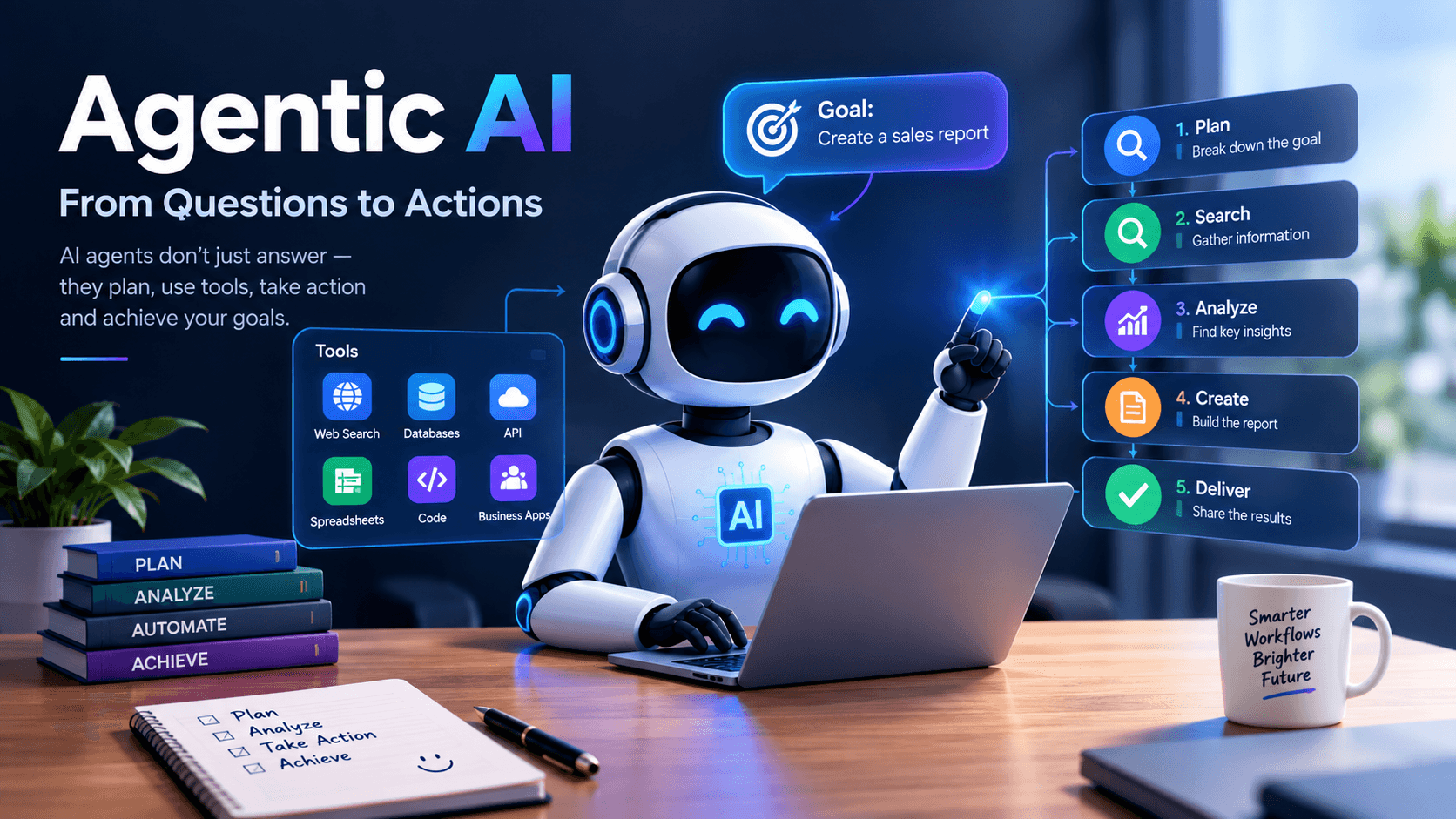
Instead of simply responding to a prompt, Agentic AI can understand a goal, plan multiple steps, use tools, make decisions, and take actions to complete a task.
In simple words, Generative AI creates content, while Agentic AI can take action to achieve a goal.
What Is Agentic AI?
Agentic AI refers to AI systems that can operate with a certain level of autonomy to achieve a specific objective.
An AI agent can receive a goal and determine the steps required to accomplish it. Depending on its design and permissions, it may interact with websites, databases, software, APIs, files, or other tools.
For example, imagine telling an AI:
"Analyze our monthly sales data and prepare a report."
A traditional AI system might explain how to analyze sales data.
An agentic AI system could potentially:
1. Access the sales data.
2. Clean and organize the data.
3. Analyze sales trends.
4. Identify important changes.
5. Create charts and visualizations.
6. Write a summary.
7. Prepare a report.
8. Ask for approval before taking any consequential action.
This ability to work through multiple steps is one of the main characteristics of Agentic AI.
How Does Agentic AI Work?
An Agentic AI system typically combines several capabilities.
1. Understanding the Goal
The AI first needs to understand what the user wants to accomplish.
For example:
Goal: "Find why website traffic decreased this month."
The agent needs to understand that this is not simply a question requiring a short answer. It may require data collection and analysis.
2. Planning
The agent can break the goal into smaller tasks.
For example:
Collect website traffic data.
Compare it with previous months.
Analyze traffic sources.
Look for unusual changes.
Identify possible causes.
Prepare findings.
3. Using Tools
AI agents become more powerful when they can use external tools.
These tools may include:
Web search
Databases
APIs
Spreadsheets
Software applications
Code execution environments
Business systems
File management tools
The AI model can decide which tool is appropriate for a particular step.
4. Taking Action
Instead of stopping after generating an answer, an agent can perform an action when it has the necessary permissions.
For example, an agent might:
Create a document.
Update a spreadsheet.
Send a draft email for approval.
Run a piece of code.
Retrieve information from a database.
Create a support ticket.
The exact capabilities depend on the tools and permissions provided to the agent.
5. Checking the Result
A useful AI agent should not blindly assume that every action worked.
It can check the result and determine whether another step is required.
For example:
Action: Run a data analysis
Result: Data contains errors
Next step: Clean the data and run the analysis again
This creates a feedback loop.
Agentic AI vs Generative AI
Agentic AI and Generative AI are related, but they are not exactly the same.
Generative AI | Agentic AI |
|---|---|
Generates content | Works toward a goal |
Usually responds to a prompt | Can perform multiple steps |
Creates text, images, code, etc. | Can use tools and perform actions |
Often requires user guidance | Can determine the next step |
Example: Write a blog | Example: Research, analyze and prepare a blog |
A generative AI model can be an important component of an AI agent, but an agent usually adds capabilities such as tools, planning, context, and action-taking.
A Simple Example of Agentic AI
Suppose a business owner says:
"Find out why our sales dropped last month."
An agentic AI workflow could look like this:
Step 1: Understand the objective
↓
Step 2: Retrieve sales data
↓
Step 3: Compare current and previous periods
↓
Step 4: Analyze products, regions, and customer segments
↓
Step 5: Identify unusual patterns
↓
Step 6: Generate charts
↓
Step 7: Prepare a report
↓
Step 8: Present the findings to the user
The important difference is that the AI is not merely answering one question. It is working through a multi-step process to accomplish an objective.
Applications of Agentic AI
Agentic AI has potential applications across many industries.
1. Customer Service
AI agents can help handle customer requests by understanding the issue, retrieving relevant information, and following predefined workflows.
For example, an agent could check an order status and prepare an appropriate response.
2. Data Analysis
AI agents can automate parts of the data analysis process.
They can potentially collect data, clean it, analyze trends, generate visualizations, and prepare reports.
3. Software Development
AI coding agents can assist developers with tasks such as:
Understanding an existing codebase
Writing code
Running tests
Identifying errors
Making corrections
Reviewing changes
Human review remains important, especially for production systems.
4. Marketing
Marketing teams can use AI agents for research and workflow automation.
An agent could help research competitors, analyze campaign data, generate content drafts, and summarize performance.
5. Business Operations
Organizations can use agentic systems to automate repetitive workflows involving multiple applications and steps.
This could reduce manual work and allow employees to focus on more complex activities.
Benefits of Agentic AI
Increased Productivity
AI agents can automate repetitive multi-step tasks and reduce the amount of manual work required.
Faster Workflows
Tasks that previously required several manual steps can potentially be completed more quickly.
Better Scalability
Businesses can use AI-powered workflows to handle larger volumes of routine tasks.
Personalized Assistance
Agents can adapt their actions according to the user's instructions, available information, and the specific task.
Continuous Workflow Automation
Unlike a simple question-and-answer system, an agent can continue working through a process until it reaches a defined stopping point or requires human input.
Challenges of Agentic AI
Despite its potential, Agentic AI also introduces important challenges.
Accuracy
An AI agent can make incorrect decisions or misunderstand information. The more actions an agent can take, the more important reliable validation becomes.
Security
Agents may interact with sensitive systems and information. Strong authentication, access controls, and permission management are therefore important.
Human Oversight
For important decisions or high-impact actions, human approval can provide an additional layer of safety.
Cost and Complexity
Building and operating an agentic system can require multiple AI models, tools, APIs, data sources, and monitoring systems.
Reliability
An agent may encounter unexpected situations. Systems need safeguards to handle failures rather than continuing with incorrect assumptions.
What Is the Future of Agentic AI?
Agentic AI is moving AI from a simple question-and-answer model toward goal-oriented workflows.
In the future, we may see more AI systems that work alongside people as digital assistants, research partners, coding assistants, data analysts, and business workflow agents.
However, the goal should not simply be to make AI more autonomous. Reliable Agentic AI also needs:
Clear objectives
Appropriate permissions
Strong security
Human oversight
Monitoring
Reliable data
Well-defined boundaries
The most useful systems will likely combine AI's ability to reason and generate information with carefully controlled access to tools and real-world systems.
Conclusion
Agentic AI is an important development in artificial intelligence.
Traditional AI systems often focus on producing an answer, while agentic systems can be designed to understand a goal, create a plan, use tools, take actions, evaluate results, and continue through multiple steps.
As AI technology continues to develop, understanding AI agents and how they work will become increasingly valuable for students, developers, businesses, and technology professionals.
In simple terms:
Generative AI helps create. Agentic AI helps accomplish.
The future of AI may not just be about asking machines questions. It may increasingly be about giving AI well-defined goals and allowing it to help carry out the work—within appropriate limits and human control.