Written by Vivexa Tech · 7 September 2026
Artificial Intelligence (AI) has shifted from science fiction concept to an everyday reality. From recommendation algorithms to automated design tools, AI powers many of the systems we interact with daily. But what actually is AI, and how does it work behind the scenes?
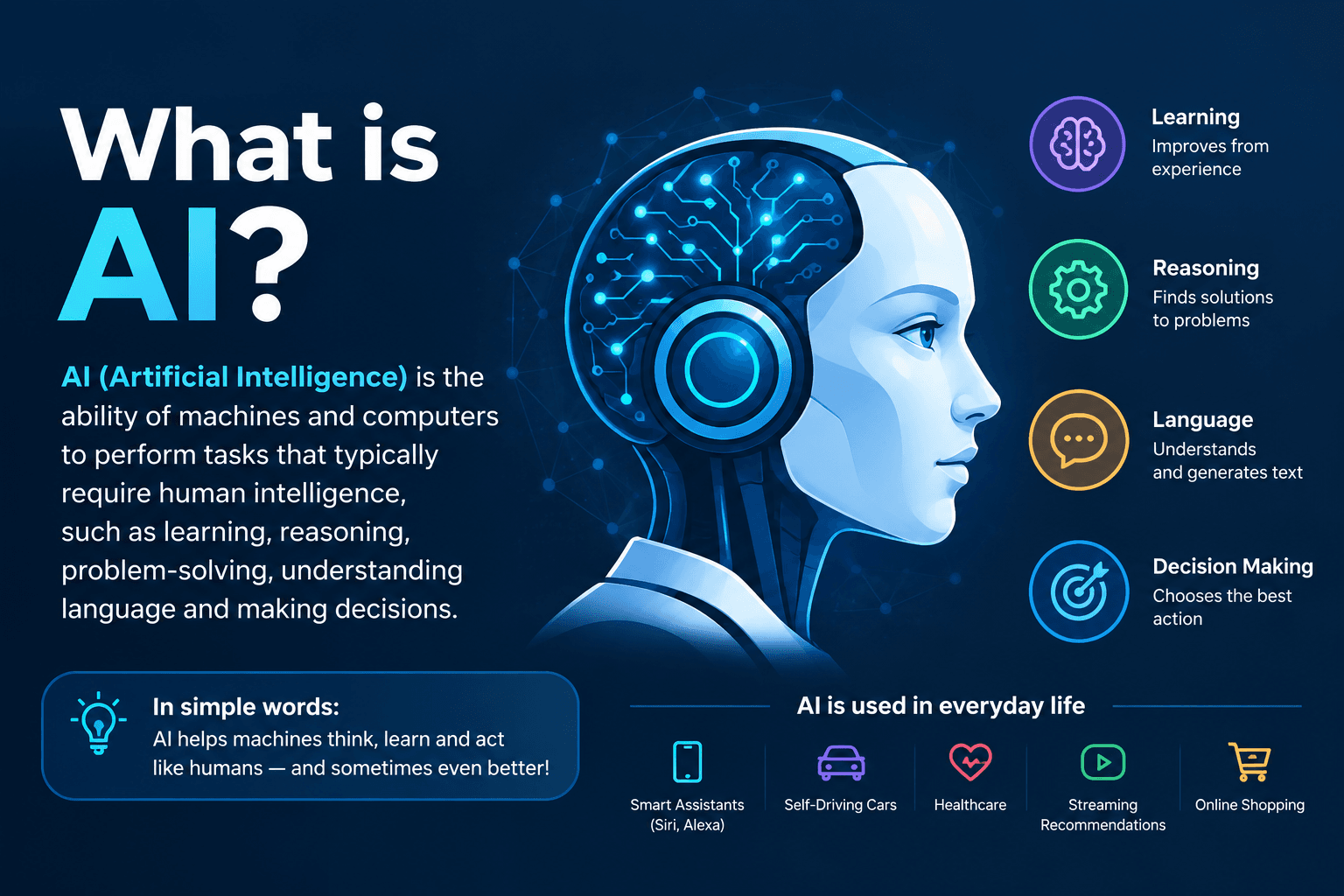
Defining Artificial Intelligence At its core, Artificial Intelligence refers to computer systems engineered to perform tasks that typically require human intelligence. This includes capabilities such as recognizing speech, learning from data, making decisions, and solving complex problems.
Rather than relying purely on static, hard-coded rules, AI systems analyze massive datasets to identify patterns and refine their output over time.
How AI Works: Key Concepts To understand AI, it helps to understand a few foundational terms:
Machine Learning (ML): A subset of AI where algorithms analyze data to learn patterns and make predictions without being explicitly programmed for every scenario.
Deep Learning: An advanced form of ML modeled on neural networks in the human brain, used for complex tasks like image processing and language translation.
Generative AI: A modern branch of AI capable of creating original text, images, code, and audio based on user prompts.
Types of AI
Narrow AI (Weak AI): Designed for a specific task. Every AI system available today falls into this category—from virtual assistants to recommendation engines.
General AI (Strong AI / AGI): Hypothetical AI that possesses human-level cognition across any intellectual domain. This does not yet exist.
Real-World Applications
Web Development & UI/UX: Personalizing user feeds, generating automated code snippets, and testing user flows.
Customer Support: Intelligent chatbots providing instant 24/7 issue resolution.
Predictive Analytics: Forecasting market trends, user behavior, and operational needs.
AI is not a replacement for human creativity; it is a powerful force multiplier that accelerates innovation when paired with human direction.